Two listings, both in North Tacoma, both marketed as historic. One sits in the North Slope Historic District. The other sits three blocks away in Stadium/Seminary. A buyer comparing them on price alone would miss the difference that actually matters: one home comes with a standing relationship with a city commission that reviews and can deny almost anything you want to do to its exterior. The other does not.
That distinction, not square footage or curb appeal, is the reason North Tacoma's "historic" price tags scatter across such a wide range depending on who's counting. Recent local pricing puts North Slope generally between $680,000 and $780,000, while separate figures place Stadium District anywhere from the high $600,000s to well over a million, depending on the mix of condos and single-family mansions in a given stretch of months. Buyers often assume that spread comes down to lot size or view. Some of it does. But a meaningful part of it comes down to which register a property sits on, because that determines whether the seller's freedom to renovate becomes the buyer's obligation to ask permission.
Two Registers, One Word
Tacoma has nine historic districts. Only four of them, the Wedge Neighborhood, North Slope, Old City Hall, and Union Depot/Warehouse, sit on the local Tacoma Register of Historic Places, which is the designation that carries binding design review. The other five, including Stadium/Seminary, Salmon Beach, South J Street, College Park, and Buckley's Addition, are listed on the state and/or National Register. According to the City of Tacoma's own historic preservation office, development activity in those state and national districts is generally unaffected by the listing except when it comes to demolition.
That single sentence from the city is the whole thesis in miniature. A home in North Slope or the Wedge cannot have its siding swapped, its roofline changed, or a dormer added without the Landmarks Preservation Commission signing off first. A home in Stadium/Seminary can be renovated on the owner's own timeline and budget, with the city stepping in only if someone tries to tear the whole structure down.
| North Slope / The Wedge (Local Register) | Stadium/Seminary (State/National Register) | |
|---|---|---|
| Governing body | Tacoma Landmarks Preservation Commission | No routine design review |
| Exterior changes | Requires review before permits are issued, per Tacoma Municipal Code 13.05.047 | Owner discretion, except demolition |
| Neighbor notification | Adjacent owners receive Commission agendas for qualifying projects | Not applicable |
| What it protects | Roofline, form, materials, massing | Nothing short of the building itself |
What a Denial Actually Looks Like
The design review process is not a rubber stamp. In 2017, an owner in North Slope submitted plans to raise a home's roof height by nearly four feet to add usable space. The proposal came back twice for briefing feedback before a formal application, and the Landmarks Preservation Commission ultimately denied it, finding the addition failed to meet the district's guidelines on compatible scale and reversibility. The commission's own minutes note that the guidelines are meant to be applied with reasonable flexibility, and that documented economic hardship should be considered, but flexibility has limits. A homeowner who buys expecting to add a floor of headroom later may find that headroom was never actually for sale.
This is not a hypothetical risk buried in a zoning code. It is a decision made in a public meeting, with a vote, about a specific house on a specific street. Anyone shopping in North Slope with renovation plans already in mind should know that plan exists at the mercy of a volunteer commission before it exists at all.
The Siding Question That Isn't About Taste
A second case from the same district, heard in 2021, shows how the commission handles cost, not just aesthetics. A North Slope homeowner asked to replace deteriorating cedar siding with HardiePlank, a fiber cement product, because cedar had become expensive and hard to source. One commissioner pointed out that HardiePlank isn't an approved material under the district's standards. The city's Historic Preservation Officer clarified that the commission had, in fact, approved HardiePlank applications in the past, typically when the condition of the original material made restoration impractical.
The resolution matters less than the pattern it reveals. Material substitutions in North Slope aren't decided by the homeowner's contractor or the homeowner's budget alone. They're decided case by case, often after a conversation about whether the original material is genuinely unavailable or just inconvenient. A buyer pricing out a full re-side of a North Slope Victorian should budget for that conversation, not just for the siding.
Your Neighbors Get a Preview Too
There's a civic wrinkle to ownership here that rarely shows up in a listing description. The city's Historic Preservation Office now provides notice to adjacent property owners whenever new construction, other than garages accessed from an alley, is proposed in North Slope or the Wedge, including any alteration that affects roofline, form, or foundation. Owners across the street or across the alley receive a copy of the Landmarks Commission's meeting agenda before the project is decided.
That means a renovation in these districts isn't a private matter between an owner and a contractor. It's visible to the block before a shovel goes in the ground. For a buyer who values discretion in how and when they modify a property, that's worth knowing well before closing, not after the notice goes out.
What the Price Actually Reflects
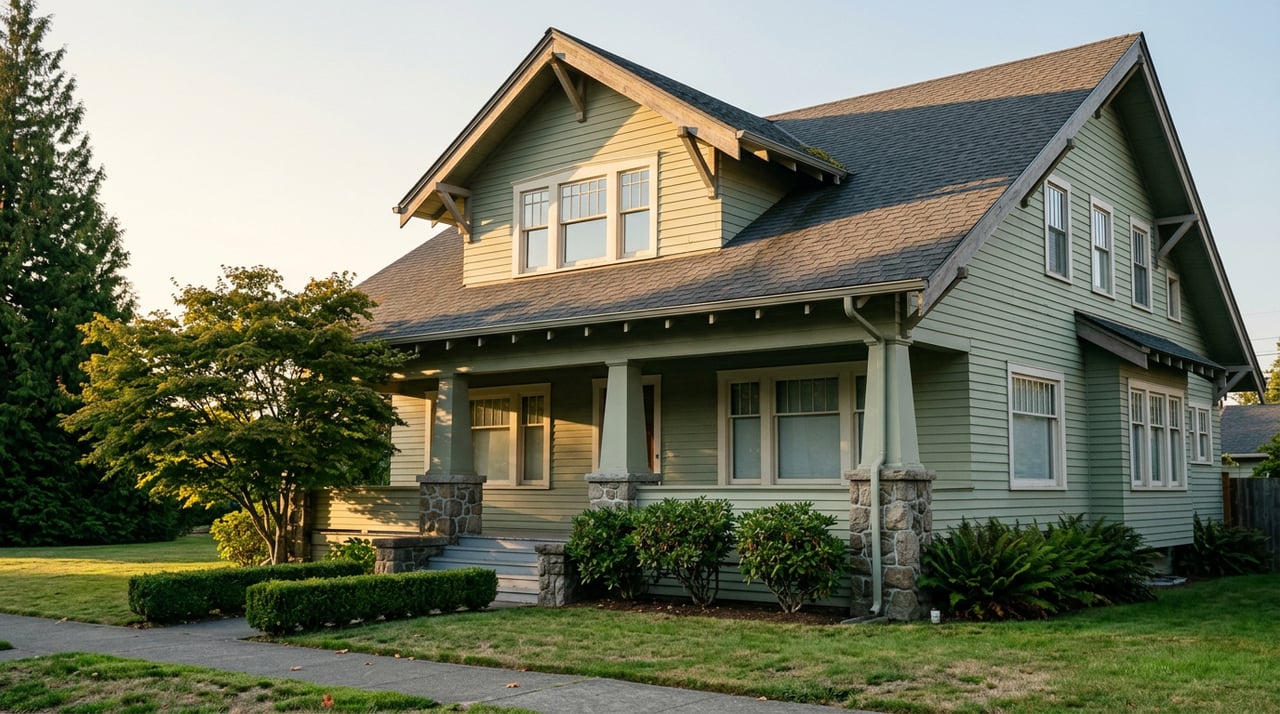
None of this means North Slope is a worse buy. Nearly 80 percent of its roughly 950 homes were built before 1930, giving the district a depth of Victorian, Craftsman, Colonial Revival, and Foursquare architecture that's genuinely hard to find intact elsewhere in Pierce County. The design review process is precisely what has kept that architecture intact for more than three decades since the district's original 1994 listing. Buyers who want the guarantee that their new neighbor won't demolish a matching Craftsman for a spec box are paying, in part, for that guarantee.
But it does mean the price gap between North Slope and Stadium/Seminary isn't only a story about views of Commencement Bay or proximity to the Proctor Farmers' Market. Stadium/Seminary's freedom from routine design review lets owners renovate, expand, and modernize on their own schedule, which can support a wider range of finished product, and a wider range of asking prices, than a district where every exterior change first goes through a public hearing. When the same city block carries two different regulatory realities under one shared label, the sale price is doing double duty: paying for the house, and paying for (or avoiding) the process that comes with it.
For buyers who want the character without the commission relationship, the condo and townhome tier in North Slope and Proctor, generally in the $450,000 to $550,000 range according to recent local reporting, often carries the architectural details of the neighborhood without the full weight of exterior design review that applies to detached single-family structures.
A Few Questions Worth Asking Before You Write an Offer
Can I paint a North Slope or Wedge home any color I want? Yes. Color choice is not subject to Landmarks review. Exterior work beyond painting and minor repair is what triggers the process.
Does design review apply to something a passerby can't see, like a heat pump compressor? The commission generally asks that mechanical equipment like compressors be placed in less visible spots, such as side or rear yards, rather than blocking review of it outright. The same practical approach applies to solar installations.
If I buy a contributing home in North Slope, am I required to restore it to its original condition? No. Owners are not obligated to reverse previous work or bring a building back to its historic form. The rules govern what you can change going forward, not what you inherited.
Does the same review apply if I buy in Old Town or Salmon Beach? Not in the same way. Those areas carry historic character and, in Salmon Beach's case, a genuinely unusual built environment of roughly 100 stilt houses along the shoreline, but they sit outside the local register's binding review structure that governs North Slope and the Wedge.
If you're weighing a purchase in one of North Tacoma's historic districts and want to understand which register a specific address falls under before you fall in love with a renovation plan, our broader guide to North Tacoma's historic homes maps the district boundaries in more detail. For a conversation about a specific property, or about pricing a home for sale inside one of these districts with the right context for buyers, Morrison House Sotheby's International Realty offers a private consultation built around exactly this kind of local detail.